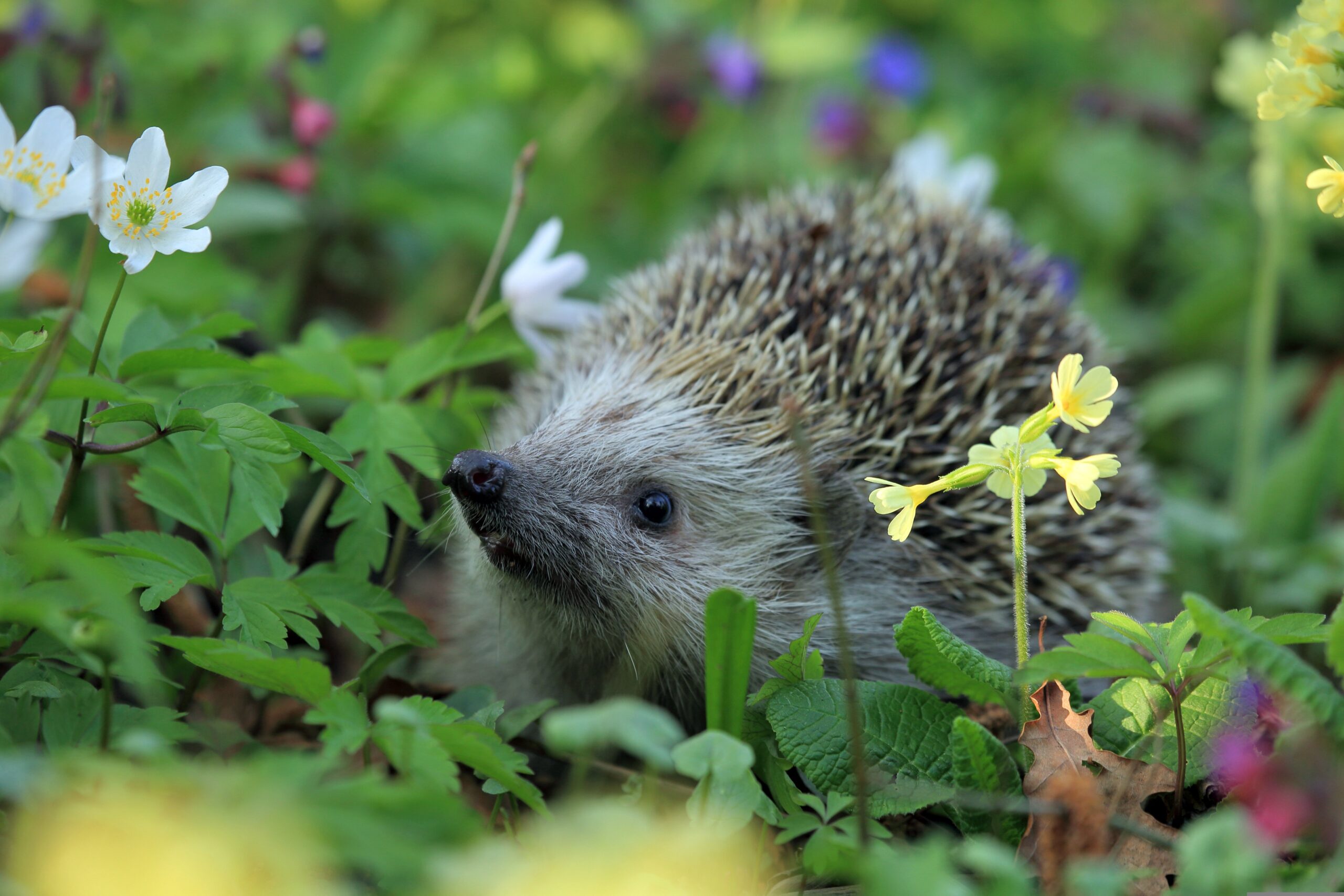
Hedgehog Awareness Week runs 3–9 May this year, and if you’re looking for hedgehog garden tips that actually make a difference, you’re in the right place. If you’ve ever spotted a hedgehog (Erinaceus europaeus) trundling across the lawn at dusk — or heard one snuffling around the compost heap — you’ll know it’s one of those encounters that stays with you.
The trouble is, those encounters are becoming rarer. Britain’s hedgehog population is now estimated at around 879,000 — and more than half have been lost from the countryside since the millennium, with declines of up to 75% recorded in some rural areas. A national survey of rural sites across England and Wales found hedgehogs present at only 22% of locations — a figure that, even accounting for survey methodology, reflects a landscape that has become genuinely inhospitable to them. Hedgehogs are now on the UK’s Red List for Mammals. This is not a gentle background decline. It’s a population in serious trouble.
But here’s the thing. Hedgehogs are exactly the kind of species where private gardens can make a genuine difference. These hedgehog garden tips are practical, science-backed, and most cost nothing at all. A well-designed wildlife garden doesn’t just support them at the margins — it can be a genuine refuge.
Here are four things worth doing before the end of May.
1. Open Up a Hedgehog Highway
This one is the entry point for a reason. Hedgehogs are wide-ranging animals — a single individual might cover a kilometre or more in a single night’s foraging. The problem is that modern garden fencing has turned most neighbourhoods into a patchwork of sealed boxes. A hedgehog can smell food on the other side of a fence panel and have no way of reaching it.
The fix is straightforward: a 13 × 13 cm hole at the base of your fence or wall. That’s it. Small enough that pets can’t follow, large enough for a hedgehog to pass through freely. If you can persuade a neighbour to do the same, you’ve just doubled the foraging range for every hedgehog passing through your garden.
The British Hedgehog Preservation Society’s “Hedgehog Street” campaign has been encouraging exactly this for years, and in some neighbourhoods entire streets have now been connected. It’s one of the rare examples of something that genuinely works at scale — but it starts with one hole in one fence.
Research also shows that hedgehogs actively seek out areas near buildings and built structures — in part, it’s thought, because these offer some refuge from badgers (Meles meles), which are the hedgehog’s principal intra-guild predator and a significant driver of rural decline. Connected suburban gardens, sitting as they do between the built environment and open ground, are well placed to act as that kind of refuge.
2. Build a Log Pile — One of the Best Passive Hedgehog Garden Tips
A log pile is one of those habitat features that rewards laziness. Pile up some logs — ideally a mix of sizes, from large rotting trunks to smaller branches — in a quiet corner of the garden, partially shaded, and then do nothing with it.
For hedgehogs, a dense log pile offers shelter and invertebrate-rich foraging habitat. Beetles, millipedes, earthworms, and slugs all colonise decaying wood, and foraging hedgehogs know exactly where to look. A well-established pile also provides overwintering sites: hedgehogs entering hibernation in October or November will seek out dense, stable structures at ground level where temperature fluctuations are minimal.
It’s worth being honest here, though. A 2025 study of hedgehog occupancy in urban gardens found that supplementary food provisioning — a bowl of hedgehog food or wet cat food left out regularly — was far and away the strongest predictor of whether hedgehogs used a garden, with 77.5% of gardens providing food being occupied compared to 49.9% without. Habitat features such as log piles and bug hotels, taken alone, showed no statistically significant effect on occupancy.
That doesn’t mean log piles are pointless. They support a wide range of other species — ground beetles, amphibians, slow-worms — and they contribute to the invertebrate community that hedgehogs depend on. But if the question is “what is the single most effective hedgehog garden tip I can act on today?”, the evidence currently points to food. A connected garden with a regular food source is more likely to hold hedgehogs than a beautifully structured garden that offers nothing to eat.
3. Hedgehog Garden Tip: Check Your Pond Has a Safe Exit
This one isn’t talked about enough. Garden ponds attract hedgehogs — they’re a reliable water source, and hedgehogs will drink from them regularly, especially in dry spells. The problem is that steep-sided ponds, or those lined with sheer butyl rubber, become traps. A hedgehog that slips in cannot climb out, and will eventually drown.
The solution is a wildlife-friendly exit: one gently sloping edge, or a ramp made from rough stone, untreated timber, or a submerged wooden plank with a piece of hessian sacking tacked over it for grip, reaching from just below the waterline to the bank. Even a section of pond edging that gradually shallows to 5–10 cm is enough.
If you’re designing a new pond, build this in from the start — one side sloped at no more than 30 degrees, with textured material underfoot. If you have an existing steep-sided pond, a wooden plank with hessian or a purpose-made pond ramp costs very little and could save a life.
This exit ramp principle matters for other garden visitors too — frogs, toads, and small mammals all benefit from the same feature.
4. Rethink the Slug Pellets
Metaldehyde slug pellets were banned from outdoor use in the UK in 2022, and that’s unambiguously good news for hedgehogs. Research has documented cases of hedgehogs dying with high levels of metaldehyde in their systems, almost certainly accumulated through eating poisoned prey items — secondary poisoning that was widely suspected but difficult to quantify.
The replacement — ferric phosphate — is generally considered safe for vertebrates, but there are concerns about the chelating agents used to increase iron absorption and their effects on earthworm populations in particular. For hedgehogs, the broader pesticide picture matters as much as slug pellets specifically. Insecticides applied to lawns and ornamental plants reduce the beetles and chafer grubs that hedgehogs depend on through autumn, when they need to build sufficient fat reserves to survive hibernation. A hedgehog entering the winter underweight is unlikely to emerge in spring.
The practical alternative isn’t doing nothing about slugs — it’s building the kind of garden where natural predators do the work. Hedgehogs, ground beetles, slow-worms (Anguis fragilis), and song thrushes (Turdus philomelos) are all effective slug controllers, and all are suppressed by the same pesticide regimes that target molluscs. The more your garden supports a functioning food web, the less you’ll need to intervene chemically.
A Note on Timing
Hedgehogs emerge from hibernation between late March and April, depending on conditions. By May, most individuals are active every night, building up reserves after the long winter fast. This is the period when access to connected foraging habitat, safe water, and an invertebrate-rich garden matters most.
Research on supplementary feeding suggests that autumn is also a critical window — hedgehogs that have access to additional food in the weeks before hibernation show improved activity levels and, by implication, better pre-hibernation body condition. So if you start leaving food out now and keep it going into October, you’re supporting hedgehogs at both ends of the active season.
These hedgehog garden tips don’t require a big budget or a large garden — just a willingness to make a few small changes and stick with them through the season. If you’re going to make one change this Hedgehog Awareness Week, make it the fence hole. Then tell your neighbour.
Wild Veitch offers wildlife garden design and consultations across Essex and surrounding counties, helping private clients create outdoor spaces that genuinely support UK biodiversity. Get in touch to find out how we can help.
References
British Hedgehog Preservation Society (no date) Helping hedgehogs — hedgehog highways. Available at: https://www.britishhedgehogs.org.uk/helping-hedgehogs-2/ (Accessed: 24 April 2026).
Chambers, T., Grover, C., Moss, E., Aegerter, J. and Cunningham, A.A. (2020) ‘Patterns of feeding by householders affect activity of hedgehogs (Erinaceus europaeus) during the hibernation period’, Animals, 10(8), p. 1344. Available at: https://pmc.ncbi.nlm.nih.gov/articles/PMC7460126/ (Accessed: 24 April 2026).
Gazzard, A., Wright, E. and Yarnell, R.W. (2025) ‘Food over features: supplementary feeding has the strongest influence on hedgehog (Erinaceus europaeus) occupancy in urban gardens’, Urban Ecosystems. Available at: https://link.springer.com/article/10.1007/s11252-025-01840-1 (Accessed: 24 April 2026).
Gemmeke, H. (1995) ‘Hedgehog deaths by secondary poisoning with metaldehyde’, cited in People’s Trust for Endangered Species (2024) Hedgehog research papers. Available at: https://ptes.org/hedgehog-papers/gemmeke-1995-hedgehog-metaldehyde-pesticides-secondary-poisoning-slugs/ (Accessed: 24 April 2026).
Hedgehog Street (no date) Do slug pellets pose a risk to hedgehogs? People’s Trust for Endangered Species & British Hedgehog Preservation Society. Available at: https://www.hedgehogstreet.org/slug-pellets/ (Accessed: 24 April 2026).
Lee, K., Wilson-Parr, R., Froy, H., Tinnesand, H.V. and Haigh, A. (2025) ‘Does differential habitat selection facilitate coexistence between badgers and hedgehogs?’, Ecology and Evolution, 15(1), e70744. Available at: https://onlinelibrary.wiley.com/doi/full/10.1002/ece3.70744 (Accessed: 24 April 2026).
Moorhouse, T.P., Goltsman, M., MacDonald, D.W. and McGowan, P. (2020) ‘Over-winter survival and nest site selection of the West-European hedgehog (Erinaceus europaeus) in arable dominated landscapes’, Animals, 10(9), p. 1449. Available at: https://pubmed.ncbi.nlm.nih.gov/32825054/ (Accessed: 24 April 2026).
Shakespear, T. and Haigh, A. (2022) The state of Britain’s hedgehogs 2022. People’s Trust for Endangered Species & British Hedgehog Preservation Society. Available at: https://www.hedgehogstreet.org/about-our-hedgehog-street-campaign/stateof/ (Accessed: 24 April 2026).
Williams, B.M., Baker, P.J., Thomas, E., Wilson, G., Judge, J. and Yarnell, R.W. (2018) ‘Reduced occupancy of hedgehogs (Erinaceus europaeus) in rural England and Wales: the influence of habitat and an asymmetric intra-guild predator’, Scientific Reports, 8(1), p. 12156. Available at: https://www.nature.com/articles/s41598-018-30130-4 (Accessed: 24 April 2026).