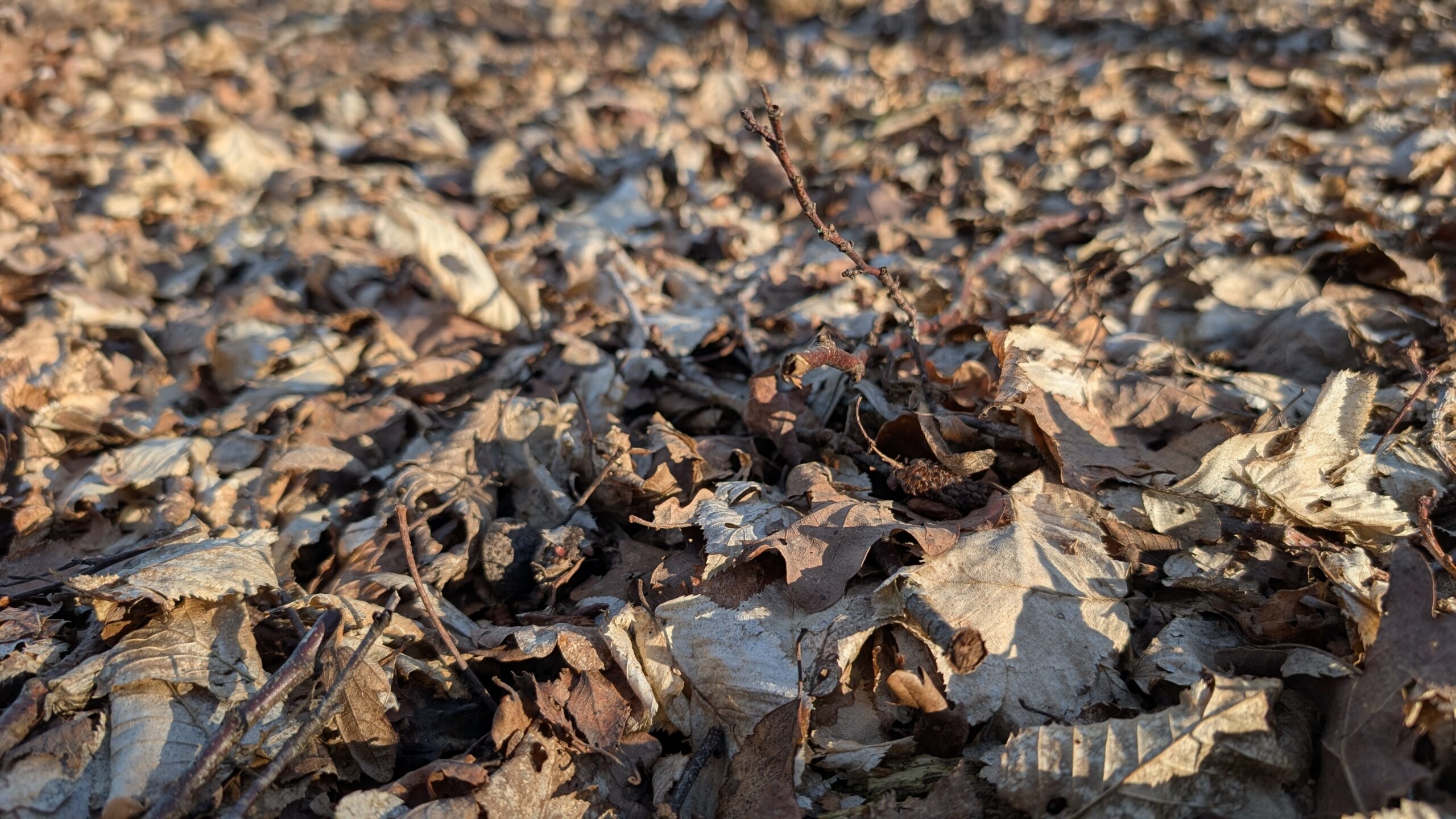
Every autumn, it happens. Leaves fall, lawns disappear, and borders fill. Many gardeners wonder whether to remove or keep leaf litter in their garden.
But before you reach for the rake, and before you decide whether to leave leaf litter in your garden or clear it away entirely, it’s worth asking a simple question:
What else are you clearing away?
Because leaf litter isn’t just seasonal clutter.
It is one of the most important structural layers in a functioning ecosystem.
🍂 Leaf Litter Is Habitat Infrastructure
In woodland systems, leaf litter is fundamental. It insulates soil, regulates moisture, supports fungi, feeds invertebrates and buffers temperature fluctuations.
It is not waste material.
Rather, it forms part of the garden’s habitat infrastructure.
When leaves accumulate, they trap air between them. This layer of trapped air slows heat loss from the soil below, reducing extreme temperature swings and limiting frost penetration.
It doesn’t make the soil warm.
It makes it stable.
And stability is critical in winter.
Winter Is a Bottleneck for Wildlife
For many species, winter survival is the hardest stage of the year.
Research into soil freezing dynamics shows that reduced surface insulation increases freeze–thaw cycles, which can damage overwintering organisms and disrupt soil biological activity.
Repeated freezing and thawing can:
Damage invertebrate tissues
Expose amphibians in shallow refuges
Disrupt soil microbial communities
Degrade soil structure
Leaf litter reduces those extremes.
Forest microclimate research demonstrates how structural layers buffer ground-level temperatures relative to exposed surfaces. Remove the structure, and you remove the buffering.
In gardens, we often strip that structure away just before the harshest conditions arrive.
What You Might Be Removing
Under a layer of leaf litter, you may find:
Ground beetles
Spiders
Bumblebee queens
Solitary bees
Butterfly pupae
Frogs and toads
Hedgehogs in sheltered nests
Clear everything in late autumn, and those organisms are left exposed.
Across the UK, wildlife populations are already under sustained pressure. Improving overwinter survival — even marginally — matters.
In a single garden, it feels small.
Across millions of gardens, it is not.
The Cultural Urge to Tidy
Neatness is aesthetic.
Ecology is structural.
There is nothing wrong with managing your garden. But there is a difference between:
Removing leaves from a lawn
Clearing paths for access
And stripping every border back to bare soil
The latter removes insulation, moisture buffering, and overwintering habitat in one sweep.
Instead of blanket tidying, think in terms of zones:
✔ Keep lawns clear if needed
✔ Keep paths safe
✔ Leave borders and hedge bases undisturbed
✔ Create intentional leaf piles in quieter corners
You can have a garden that feels cared for and still functions ecologically.
Snow on Top. Life Beneath.
When snow falls onto a leaf-littered border, two insulating layers now exist:
Snow
Organic litter
Below them, soil temperatures fluctuate less than exposed ground.
While lawns freeze hard, life continues quietly beneath the leaves.
The difference is structural, not sentimental.
🍂 Why Leaf Litter in Your Garden Matters in Winter
Wildlife gardening is not about adding more.
Sometimes it is about removing less.
Leaving leaf litter in your garden through winter can make a measurable difference to wildlife survival.
Before clearing leaves from every corner this autumn, pause and ask:
Is this genuinely necessary — or simply a habit?
Small structural decisions made at the right time can make a measurable difference to overwinter survival.
And winter survival shapes spring abundance.
If you notice wildlife using your garden habitat, you can also record sightings using some excellent wildlife identification apps.
References
Burns, F. et al. (2020) The State of the UK’s Birds 2020. Sandy: RSPB, BTO, WWT, JNCC, NE, NatureScot and NRW.
Campbell, G.S. & Norman, J.M. (1998) An Introduction to Environmental Biophysics. 2nd edn. New York: Springer.
De Frenne, P. et al. (2013) ‘Microclimate moderates plant responses to macroclimate warming’, Global Change Biology, 19(12), pp. 3525–3538.
Facelli, J.M. & Pickett, S.T.A. (1991) ‘Plant litter: its dynamics and effects on plant community structure’, The Botanical Review, 57(1), pp. 1–32.
Groffman, P.M. et al. (2001) ‘Colder soils in a warmer world: a snow manipulation study in a northern hardwood forest ecosystem’, Biogeochemistry, 56(2), pp. 135–150.
Henry, H.A.L. (2008) ‘Climate change and soil freezing dynamics: historical trends and projected changes’, Climatic Change, 87(3–4), pp. 421–434.