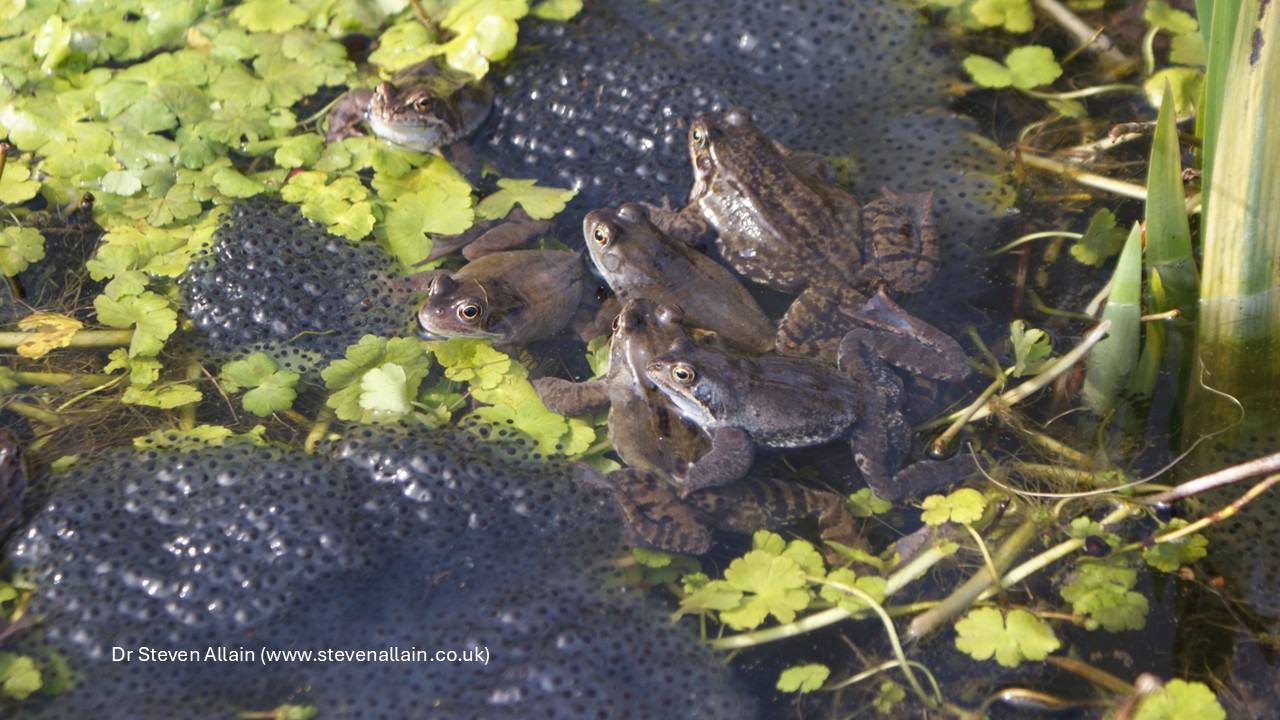
Late winter is one of my favourite times in the garden, especially when a well-designed wildlife pond begins to show signs of life.
It still feels quiet — but beneath the surface, things are starting to move. And one of the first real signs of spring in the UK is the appearance of frogspawn in ponds.
Good wildlife pond design determines whether your pond becomes a functioning breeding habitat — or just a body of water.
For some people, it’s an annual event. For others, it never seems to happen.
So why do some ponds fill with spawn every year, while others stay completely untouched?
It isn’t luck.
It’s habitat.
🐸 When Does Frogspawn Appear in Wildlife Ponds?
The common frog (Rana temporaria) usually breeds between late February and March, depending on the temperature.
They return to ponds to lay their eggs in shallow water, attaching clumps of spawn to submerged plants.
But frogs are surprisingly selective. They don’t just use any water feature.
And that’s where pond design really matters.
Why Some Ponds Don’t Attract Frogs
Many modern garden ponds are designed to look neat rather than to function ecologically.
Common issues I see include:
Steep or vertical sides
Deep water throughout
Gravel bottoms with little planting
Fish
Constant filtration systems
They can look lovely — but they don’t provide what amphibians need.
Frogs aren’t looking for a showpiece.
They’re looking for safety.
What Makes a Proper Wildlife Pond?
If you want your pond to support frogs (and newts, dragonflies and other freshwater life), there are a few key principles.
1️⃣ Gently Shelving Edges
Shallow margins are critical.
Most frogspawn is laid in water just a few centimetres deep. Gradual slopes allow frogs to enter and leave easily, and the shallows warm up faster, which helps egg development.
Vertical-sided ponds often make access difficult and can trap wildlife.
2️⃣ Clean, Low-Nutrient Water
Rainwater is ideal where possible.
Tap water can encourage algae growth, and nutrient run-off from lawns or fertilisers can quickly tip a pond out of balance.
Wildlife ponds don’t need to be crystal clear — but they do need to be stable.
3️⃣ No Fish
This is probably the biggest misconception.
Fish — even small ones — will eat frogspawn and tadpoles.
In the wild, many small ponds are naturally fish-free, which is exactly why amphibians use them.
If frogs are your priority, avoid adding fish.
4️⃣ Structure and Planting
Frogs attach their spawn to submerged vegetation.
A good wildlife pond includes:
Submerged plants
Emergent plants around the margins
Areas of open water
It’s the structure that matters — not decorative gravel.
5️⃣ Habitat Around the Pond
This is often overlooked.
Frogs spend most of the year on land, sheltering in:
Log piles
Leaf litter
Hedgerows
Rough grass
Dense planting
A tidy lawn with a pond in the middle is rarely enough.
Ponds only function properly when the surrounding habitat supports them.
Why Garden Ponds Matter
We’ve lost around half a million natural ponds across the UK over the last century.
But we now have millions of garden ponds.
Collectively, they form an important network for amphibians and freshwater wildlife — especially in urban and suburban areas.
A properly designed garden pond isn’t just decorative.
It’s part of a wider ecological system.
Is Your Pond Wildlife-Friendly?
If you’re not sure whether your pond is working ecologically, it’s usually easy to assess.
Sometimes small adjustments — improving margins, adjusting planting, removing fish, adding surrounding habitat — can make a big difference.
And if you’re thinking of creating a new pond, getting the design right from the start avoids problems later.
Final Thought
When frogspawn appears in your pond, it’s a sign that your garden is connected to something bigger.
It means amphibians have found a safe habitat.
And that’s something worth building deliberately.
If you’d like a structured Wildlife Garden Audit to assess your pond and wider habitat, get in touch to discuss options.
References
Amphibian and Reptile Conservation (2020). Amphibians and Reptiles in Your Garden.
Beebee, T.J.C. & Griffiths, R.A. (2000). Amphibians and Reptiles: A Natural History of the British Herpetofauna. HarperCollins.
Freshwater Habitats Trust (2023). Creating Garden Ponds for Wildlife. Available at: https://freshwaterhabitats.org.uk
FWAG East (2023). Great Crested Newt – Pond Specifications.